
Reinvigorating City Waterfronts: Why Legacy Barges Are Holding Back Innovation
- Jan 18
- 5 min read
For decades, when maritime waterfront project leaders needed a non-permanent structure, the standard barge or pontoon was the default. It is cheap, after all.
But what if that 'cheap' starting point was actually a financial trap, leading to stranded assets and operational headaches?

The truth is that the demands on maritime infrastructure have far outpaced the technology used to build it.
Retrofit platforms are fine for temporary use, but the moment you add complex occupancy, utilities and energy systems, the risk and cost profile changes.
While the maritime industry has evolved, many projects still rely on antiquated and simplistic barge structures.
Now the industry is learning that the low initial cost of a barge is merely the starting point for a marathon of hidden expenses, structural retrofits, and regulatory hurdles.
Those cheap “solutions” have become a financial and operational crisis, leading to budget overruns, safety risks, and stranded assets.
Andy King, VP Naval Architect, ELIRE Infra – on Structural and Regulatory Limitations
"Barges were never originally designed to house buildings. The moment you add permanent structures, with through-life modifications & retrofits youre redefining loadings, and fighting against the original design's structural arrangement. This can lead to structural integration issues, driving costly rework and the potential for stability reassessments, all set against a web of regulatory framework conflicts between marine vessels and civil infrastructure. It’s an engineering compromise from day one.”
For Ports & Marinas Managers, Developers, and Investors, these are the inherent risks that make the conventional path with standard barges untenable:
The Cost of Retrofitting Technology
Barges are built for transport, not for complex integration. Adding modern features like microgrids, energy-to-power, or technical systems requires ad-hoc penetrations and hot-work that compromise watertight integrity and structural safety.
This unplanned process introduces critical risk and makes the project's budget unpredictable.
Regulatory & Insurance Ambiguity
When adapted for public use (e.g., as a terminal or event space), the barge's classification as a vessel inevitably conflicts with local building and occupancy codes. This ambiguity complicates approvals, increases insurance premiums, and makes it nearly impossible to finance or lease the asset under many standard frameworks, locking the operator into a full CAPEX burden.
Iain Hepplewhite, VP Construction, ELIRE Infra – on Buildability and Integration Risk
“What looks simple on paper becomes chaos on-site. Retrofitting utilities, adding ballast, cutting access hatches, and welding reinforcement on a used barge is an exercise in rework. Each adjustment adds weeks, new subcontractors, and risk to the safety case. With our solutions, 80% of that coordination and risk simply disappears because it’s designed in, not bolted on.”
Operational Inflexibility & Stranded Assets

Barges are not designed for concentrated loads (like buildings) and lack native modularity. Most are built almost entirely from steel due to its strength, relative affordability, and ease of welding, making fabrication and repair straightforward.
However, adapting them requires costly deck reinforcement and triggers re-stability analysis after every single change, adding crippling time and cost. The final structure becomes a single-purpose, stranded asset that cannot easily be moved, repurposed, or scaled without significant downtime and risk.
At a large scale, aluminium can drive higher structural depth and more complex joining to meet stiffness and fatigue requirements. It’s also a better option where weight reduction and corrosion resistance are prioritised.
Time-to-Market and Project Risk
A typical project timeline is inherently risky and unpredictable (24–45 weeks), as schedules tend to swell during the retrofit phase, regulatory approvals, and costly re-stability and rework, causing inevitable delays and budget overruns.
ELIRE Smart Hub Systems: The Appreciating Assets

Now there’s an entirely new class of infrastructure engineered and designed to solve the problems that conventional barges only compound: ELIRE Smart Hubs set a new standard for profitable and future-proof marine infrastructure.
The Smart Hub is not simply a vessel but a purpose-built infrastructure platform, designed from day one with class certifications for floating assets to deliver the financial agility and technical resilience required for the 21st century. It provides a direct solution to every risk posed by conventional barges.
Here’s why these purpose-built solutions are a better alternative for ROI and long-term viability:
Financial Agility & Predictable CAPEX
The Smart Hub's 80% plug-and-play engineering & design eliminates the hidden costs of welding, reinforcement, and regulatory rework that derail barge budgets.
This provides CAPEX certainty and ensures a faster ROI.
More importantly, its classification as infrastructure enables superior lease-to-operate models and SPV financing, shifting investment from CAPEX-heavy bespoke builds to OPEX-based leasing.
Tech-First, Zero-Friction Integration
Smart Hubs are Tech-First. They feature pre-engineered foundations, including integrated microgrid bays, and segregated cable/pipe routes for the energy-to-power solutions and buildings.
This robust, built-in design ensures zero-friction integration of clean energy, power, building structures, and data systems, preserving watertight integrity and structural safety without the time, cost, and risk of conventional retrofitting.
Modular Growth & Lifecycle Value
Smart Hubs are inherently modular and scalable, featuring native connectors that enable seamless expansion from 400 sqm to multi-hectare complexes.
The timeline for the Smart Hubs system build & installation is reliable and compressed (26–43 weeks), as the plug-and-play solution reduces rework and fragmentation.
This multi-purpose design allows the platforms to be easily disassembled, relocated, or repurposed over a long lifecycle, guaranteeing a superior residual value and eliminating stranded asset risk.
Ben Blezard, VP Procurement, ELIRE Infra – on Financial and Supply-Chain Implications
“When you buy a barge, you’re not buying a solution, you’re buying a shell and a long list of unknowns. The supply chain for retrofits is fragmented and unpredictable: marine steel, coatings, mooring hardware, fire systems, and class approvals all come from different vendors. With Smart Hubs, we have one integrated procurement pathway, predictable cost control, and real asset value at the end.”

A Strategic Decision
The choice between a conventional barge and an ELIRE Infra Smart Hub system is not a decision about initial fabrication cost; it's a strategic choice about the future value and viability of your asset.
While a conventional barge offers a deceptively low entry point, that cost quickly becomes an unrecoverable expense through the marathon of welding, complex retrofitting, regulatory uncertainty, and lost operational time.
This process creates a single-purpose, depreciating vessel burdened with high OPEX and limited resale options.
The Smart Hub system, however, is a de-risked investment in infrastructure flexibility. It eliminates the hidden costs of complexity, guaranteeing a predictable timeline and a clear compliance pathway.
More importantly, its modular, multi-purpose design future-proofs your investment, allowing the platform to be easily repurposed, relocated, or scaled to meet the next wave of energy or public demand.
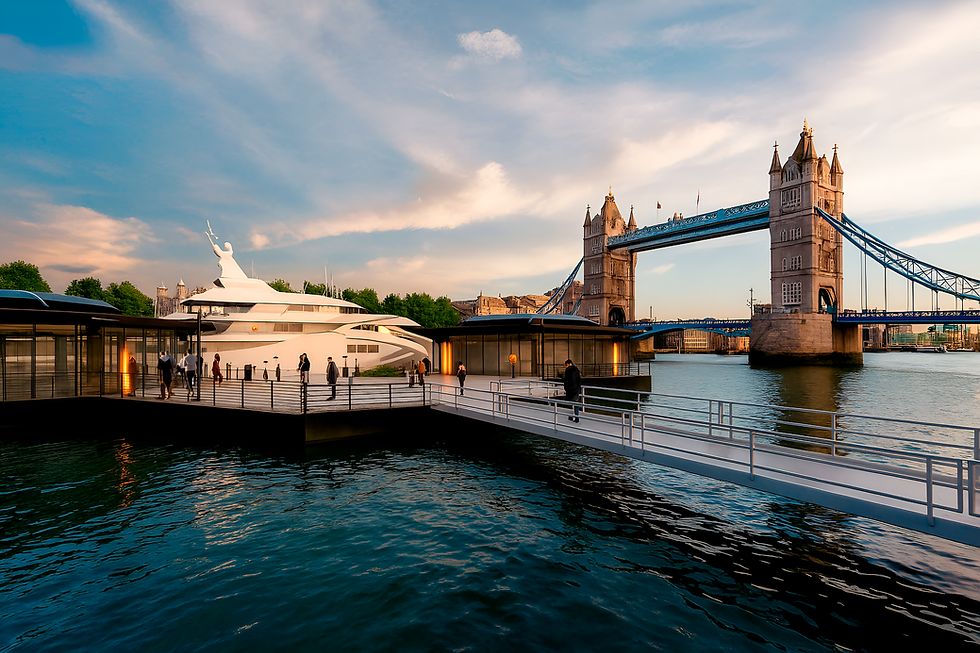
You can reconfigure buildings without changing the platform, rearrange multihub installations at different locations, and upgrade technical facilities through equipment swap. That’s because the substructure is designed to allow this flexibility, rather than being tailored only for one use case.
To meet the urgent demands of net-zero and the need for resilient, high-value waterfront assets, project leaders must pivot from obsolete vessel technology to modern infrastructure solutions. ELIRE Smart Hubs are the asset class of tomorrow.
Chris Carlisle, VP Energy to Power, ELIRE Infra, – on Technology and Decarbonisation Challenges
“Trying to integrate microgrids or hydrogen systems onto an old barge is like wiring a data centre into a cargo hold. There’s no segregation for cabling, no thermal management, and every penetration risks watertight integrity. Smart Hubs flip the model, they’re built with dedicated energy bays, conduits, and control infrastructure from day one, enabling safe, scalable, and compliant power delivery.”
Choose the platform that promises not just capacity, but financial agility and long-term strategic advantage.
Contact our team to find out how you can benefit from a purpose-built, future-proof infrastructure asset.


Comments